The Case for Firing Half Your Wellness Routine in 2026

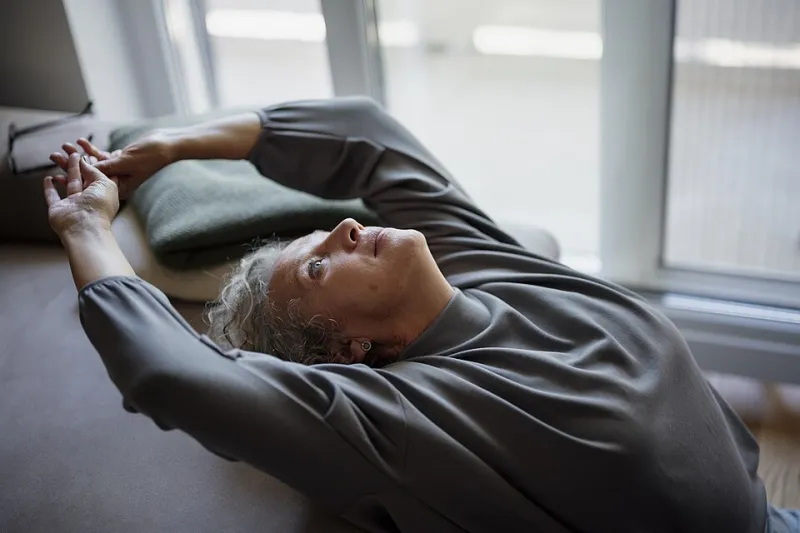
Photo: Marjory Collins, Public domain, via Wikimedia Commons
Somewhere in the last few years, taking care of yourself turned into a project management role.
There's the morning stack. The evening stack. The sleep score you check before your feet hit the floor. The continuous glucose monitor you bought and now feel guilty about. The cold plunge you dread. The red light panel you're not entirely sure how to use. The quarterly blood panel, the twelve biomarkers you can't interpret, and a spreadsheet tracking all of it.
None of this is evil. Some of it helps. But somewhere in the middle of all that optimization, a lot of Americans have quietly become more stressed about their health than they were before they started working on it.
That's worth naming in 2026.
How optimization became the default
Part of this is technology. When a device hands you a number, the instinct is to change the number. Sleep score of 68? Better fiddle with something. Readiness score in the yellow? Cancel the run.
The other part is economic. Optimization is a great business model. Fundamentals like walking and going to bed on time don't generate recurring revenue. A subscription, a protocol, and a twelve-week program do.
And part of it is genuinely good faith. People want to feel better and are willing to do the work. The problem isn't motivation. It's that the work being sold is often far more elaborate than the work that's actually supported by evidence.
The bill nobody itemizes
The costs of over-optimizing are rarely dramatic. They're the slow kind.
There's the attention cost — the mental bandwidth spent reviewing data that mostly just tells you what you already knew. There's the substitution problem, where tracking a behavior starts to feel like doing the behavior. There's the anxiety loop, where a bad score produces stress, and stress produces a bad score.
And there's the simple math of dilution. If you're managing eleven interventions, you're probably doing none of them particularly well. Three of them done consistently will outperform eleven done sporadically, every single time.
What the evidence actually rewards
The frustrating thing about the fundamentals is how boring they are. But the list is short and it hasn't changed much:
- Sleeping roughly seven to nine hours, on a consistent schedule
- Moving your body most days, including some resistance work and some walking
- Eating enough protein and fiber, and mostly recognizable food
- Maintaining relationships you'd call on in a crisis
- Not smoking, and keeping alcohol low or absent
- Getting outside, especially in the morning
That's it. That's the list that does the heavy lifting. Everything else — every powder, every tracker, every thirty-day protocol — is operating in the margins of that list, and a lot of it operates in the margins so far out they may as well be rounding errors.
None of this is a knock on legitimate tools. A CPAP machine for sleep apnea is transformative. A continuous glucose monitor can be genuinely useful for someone with diabetes or prediabetes. Bloodwork catches real problems. The argument isn't against tools — it's against the assumption that more tools mean more health.
A shorter list for 2026
If you're looking for permission to cut, here it is. Consider dropping:
The supplement stack that grew without a plan. Most people don't know why they're taking half of it. Keep what a clinician recommended for a specific reason. Let the rest go.
The metric you feel bad about. If a number on a screen makes you anxious more than it makes you act, it's not information anymore. It's a mood.
The protocol you're doing for an identity. If you'd stop doing it the moment nobody was impressed, that's worth noticing.
The hundred-dollar purchase you haven't taken out of the box. Self-explanatory.
And consider keeping exactly one thing to measure — the one that reliably changes your behavior. For some people that's a step count. For others it's a weight log or a training journal. One. Not nine.
The thing that actually gets lost
Health isn't a puzzle to solve. It's a set of conditions you maintain, mostly through repetition of small, unglamorous acts. The person who walks after dinner every night and goes to bed at eleven is, statistically, doing more for themselves than the person running a six-supplement stack and a nightly biohacking routine they hate.
Doing less isn't laziness. It's editing. It's deciding that the point of all this was to feel good and live well, not to produce a flawless dashboard.
So here's the permission slip, dated 2026. You can close the app. You can skip the stack. You can go to bed without a score. You can walk around the block and call it a wellness routine, because it is one.
The boring version works. It always has.