Stretching Every Day But Getting Weaker? Here's What's Actually Going On
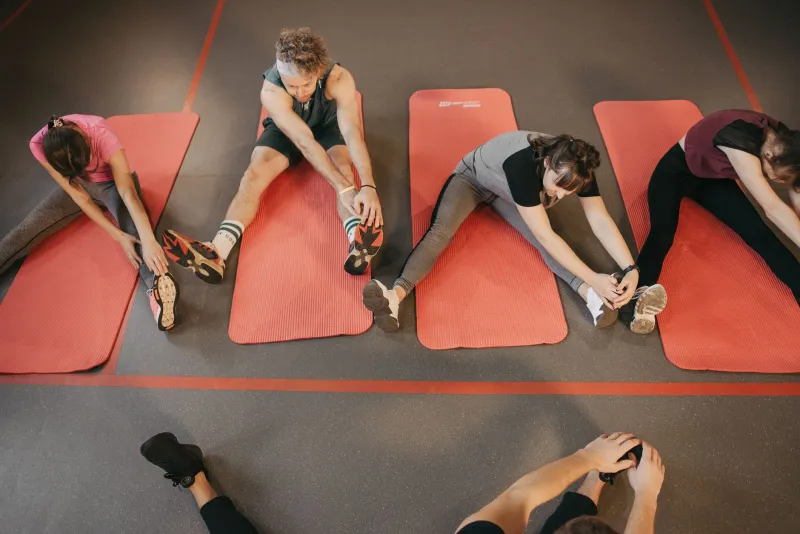
There's a version of the wellness playbook that almost everyone in America is running from. You wake up, roll out a mat, spend 20 minutes stretching everything that feels tight, and then feel virtuous about it before your day even starts. Or maybe you hit the gym, spend a solid chunk of time loosening up with long static holds, and then wonder why your lifts feel flat.
Here's the uncomfortable part: that routine might be working against you.
Not because stretching is bad. It's not. But the way most people stretch — how much, when, and what they expect it to accomplish — is based on a belief system that exercise science has been quietly dismantling for years.
The Flexibility Myth We All Inherited
For decades, flexibility was treated as a near-universal good. The more range of motion you had, the healthier and more injury-proof you were assumed to be. PE teachers had kids doing toe touches. Coaches mandated long static stretches before every practice. Yoga became synonymous with wellness itself.
The logic seemed airtight: tight muscles lead to injury, so looser muscles must mean safer movement. Simple enough.
Except the research started telling a different story.
A wave of studies — many now replicated across different populations and sports — found that prolonged static stretching performed immediately before activity can actually reduce strength output, power, and performance. We're talking measurable drops. One frequently cited analysis found that static stretching held for 60 seconds or more before exercise reduced muscle strength by roughly 5 to 8 percent on average, with some studies clocking losses as high as 30 percent in explosive activities like sprinting and jumping.
That's not a rounding error. That's real.
What's Happening Inside the Muscle
To understand why, it helps to think of your muscles less like rubber bands and more like springs. Springs work best when they have tension — when they're primed and ready to snap back. Static stretching, especially long-duration holds, temporarily reduces that tension. It essentially tells the nervous system to dial down its readiness signal to the muscle.
This is called decreased neuromuscular activation, and it's exactly what you don't want before you're about to ask your body to perform.
Your muscles also have something called the stretch-shortening cycle — a rapid sequence where a muscle lengthens and then immediately contracts to generate power. Think of jumping: your legs load (lengthen) and then explode (shorten). That cycle depends on the muscle being in a state of readiness. Excessive pre-workout stretching interrupts that readiness, which is why athletes who stretch extensively before explosive activities often see measurable performance drops.
The Hypermobility Problem Nobody Talks About
There's another angle to this that goes beyond pre-workout timing: the problem of too much flexibility without enough stability to support it.
Hypermobility — having an unusually large range of motion in joints — sounds like a superpower. In reality, it often comes with a catch. When joints can move beyond what the surrounding muscles and connective tissue can actively control, you've got a stability problem. The joint is loose in ways the body can't manage, and that's when injury risk actually goes up, not down.
This is why you'll see physical therapists working with hypermobile patients not to increase their range of motion, but to reduce it — or more precisely, to build the muscular strength and control that lets the body govern that range safely.
A lot of people who stretch obsessively are unknowingly pushing themselves further into this territory. They feel tight, so they stretch more. But sometimes that tightness isn't a flexibility problem — it's the nervous system gripping down to protect a joint that doesn't have enough muscular support around it.
Stretching that tightness away without addressing the underlying instability is like loosening the guardrails on a mountain road because the car feels too constrained.
Mobility vs. Flexibility: They're Not the Same Thing
This is where a lot of the confusion lives. Flexibility is passive — it's how far a joint or muscle can move when an outside force (like gravity, or your hand pulling your leg toward your chest) assists it. Mobility is active — it's how far you can move a joint through its range using your own muscular control.
Mobility is what actually matters for performance and injury prevention. You can be incredibly flexible and have terrible mobility. You might be able to push your leg into a full split passively, but if your hip flexors and glutes can't actively control that range, you're not actually mobile — you're just loose.
The goal isn't to keep adding range. The goal is to own the range you already have.
So When Should You Stretch?
None of this means you should throw out your yoga mat or skip your cool-down. Context is everything.
Before a workout: Skip the long static holds. Instead, use dynamic movement — leg swings, hip circles, arm rotations, walking lunges. These warm the tissue, activate the nervous system, and prepare the body to move without dulling its readiness.
After a workout: This is when static stretching earns its place. Your muscles are warm, your nervous system has already done its job, and holding a stretch for 30 to 60 seconds can genuinely help with recovery and long-term range of motion over time.
On rest days: Light stretching or yoga-style movement is great here — it promotes blood flow, supports recovery, and feels good. Just don't confuse it with strength work or assume it's building the stability your body actually needs.
If you're already very flexible: Talk to a trainer or physical therapist about shifting your focus toward strength through range of motion — things like deep squats with control, Romanian deadlifts, and single-leg work that builds the muscular architecture to support your joints.
The Smarter Framework
Think of it this way: flexibility is a raw material. Mobility is the finished product. And stability is the foundation the whole thing rests on.
If you're only working on flexibility — stretching more, going deeper, trying to get looser — you're collecting raw material without building anything with it. At some point, more raw material becomes clutter.
The real work is developing strength through your full range of motion. That means resisting at the end of a movement, not just relaxing into it. It means training your muscles to be long and strong simultaneously, which is a very different ask than just holding a stretch.
Yoga, when practiced with that intention, can absolutely deliver this. So can resistance training with full range of motion, mobility-focused strength work, and even some Pilates approaches. The common thread is that the nervous system is engaged and the muscles are working — not just releasing.
The Takeaway
Stretching isn't the enemy. Mindless stretching, done at the wrong time and without a bigger picture in mind, can be.
If you've been putting in the mat time and still feeling weak, unstable, or perpetually tight in the same spots — it might be time to stop asking your body to get looser and start asking it to get stronger. Sometimes the most counterintuitive move is the one that actually gets you somewhere.